
Keeping a home running smoothly isn’t just about cleaning more—it’s about cleaning smarter. If you’re looking for practical ways to improve your space, streamline routines, and extend the life of your appliances, you’re in the right place. This article is designed to help you upgrade your household habits and productivity with expert-backed insights on interior inspiration, smart appliance care, pristine home maintenance, and efficient washing system upkeep.
Many homeowners struggle with inconsistent routines, overlooked maintenance, and appliances that don’t perform at their best. We’ve gathered proven strategies, practical tips, and industry-informed guidance to help you avoid costly mistakes and create a home that feels organized, efficient, and truly refreshing.
From simple daily adjustments to deeper maintenance strategies, you’ll find clear, actionable advice that aligns with your goal: a cleaner, smarter, and more harmonious living space—without adding unnecessary stress to your routine.
Feeling buried under laundry piles and endless to-do lists is exhausting. The cycle of chores can feel like running on a hamster wheel—lots of motion, zero progress. The real problem isn’t laziness; it’s the lack of a SYSTEM. Without structure, household habits and productivity clash, creating mental clutter as thick as a junk drawer. What if your home ran like a well-tuned engine? This guide delivers a clear, actionable framework to streamline routines, reduce clutter, and automate tasks using proven organization principles and smart tech. The result: more TIME, more energy, and a home that practically manages itself for you.
The Foundation: Establishing Zones and a “One-Touch” Rule
First, let’s define zoning. Zoning is the practice of assigning a specific purpose and “home” for every item in a room—a mail station for letters, a hook for keys, a rack for shoes. In other words, everything belongs somewhere (and if it doesn’t, that’s your first clue). The benefit? You eliminate decision fatigue and stop clutter before it starts.
Next, create a drop zone near your entryway. This is a small, intentional setup—think tray for wallets, basket for bags, wall hooks for coats. Instead of scattering items across the house, everything lands in one controlled space. As a result, you save time searching and reduce visual stress the moment you walk in.
Then there’s the One-Touch Rule: handle an item once. Open mail and immediately recycle, file, or act on it. Don’t shuffle it from counter to table to desk (we’ve all done it). This simple habit dramatically improves household habits and productivity.
Actionable Step
This week:
- Identify your top 3 clutter hotspots
- Assign a clear zone for each
- Add simple containers or hooks where needed
The payoff is real: less mess, faster cleanups, and a home that works with you—not against you.
Automate Your Tidiness: The Daily Reset and Weekly Batching
Ever walk into your kitchen at night and think, “I’ll deal with it tomorrow”? And then tomorrow somehow multiplies the mess? Sound familiar?
The solution isn’t a massive weekend overhaul. It’s a SYSTEM.
The 15-Minute Daily Reset
A daily reset is a non-negotiable 15-minute routine you complete every evening to return your home to a neutral baseline. Neutral doesn’t mean spotless. It means functional and calm (there’s a difference).
A simple checklist might include:
- Load and run the dishwasher
- Wipe down kitchen counters
- Put away stray items
- Prep coffee for the morning
- Clear and reset the living room surfaces
Research shows small, consistent routines reduce cognitive overload and stress (American Psychological Association). So why do some people argue daily resets are unnecessary? They claim it’s easier to “just clean on the weekend.” But here’s the catch: deferred mess compounds. Fifteen minutes daily often replaces hours later.
Pro tip: set a timer. When the clock runs, you stop. No perfection spiral.
The Power of Task Batching
Batching means grouping similar tasks into one focused block to reduce “task switching,” which productivity studies link to lower efficiency (APA). Instead of scattering chores all week, consolidate them.
Try this:
- Laundry on one designated day
- Meal prep for 2–3 hours once a week
- All errands in a single trip
Have you noticed how this supports better household habits and productivity? It creates rhythm.
And if you’re curious about how your environment shapes your mindset, explore how home design influences mood and well being: https://livpristwash.com/how-home-design-influences-mood-and-well-being/
Small resets. Smart batching. BIG difference.
Let Technology Do the Heavy Lifting: Smart Home Integration
Ever notice how the smallest chores somehow eat the biggest chunks of your day? You sweep, you wipe, you start laundry—then repeat. It’s not exhausting because it’s hard. It’s exhausting because it’s constant. Decision fatigue (the mental drain from making too many small choices) is real, and your home shouldn’t be adding to it.
Smart home integration shifts the load.
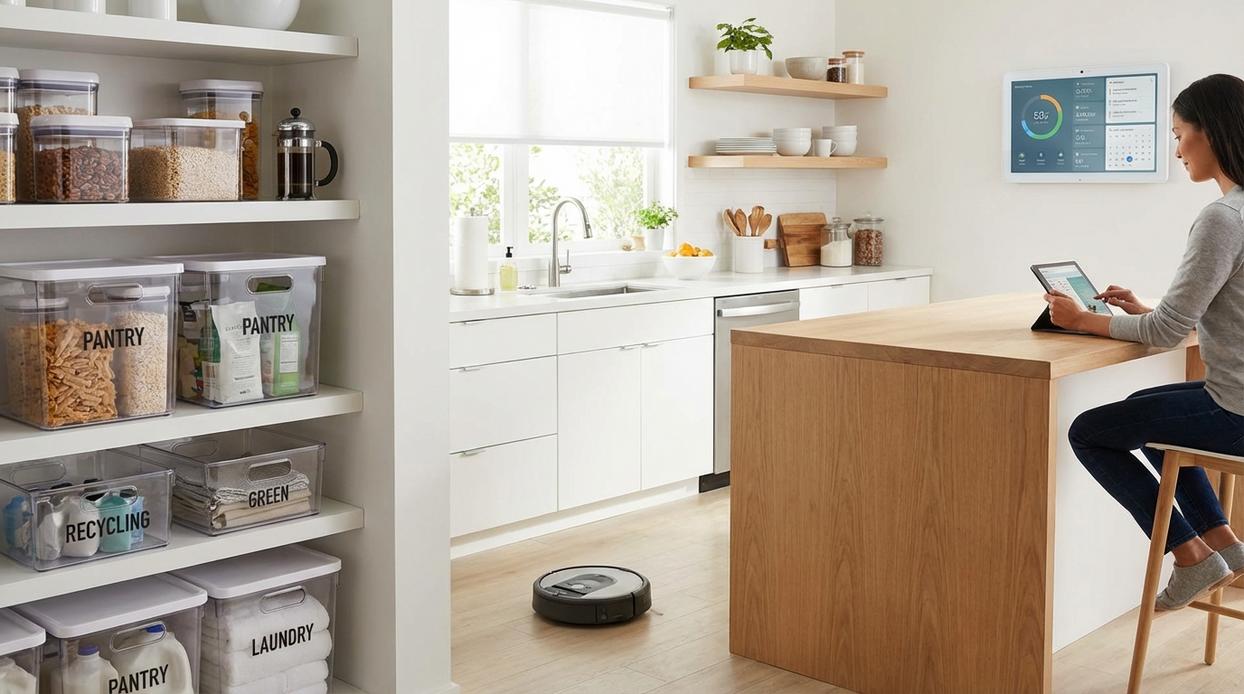
Take smart cleaning appliances:
- Robotic vacuums and mops handle daily floor maintenance automatically.
- Smart washing machines can be scheduled during off-peak hours to save energy and money (yes, your utility bill notices).
Set a robotic vacuum to run overnight, and you wake up to clean floors. No mental debate. No “I’ll do it later.” Just done. That’s an immediate efficiency win.
Kitchen automation tackles another frustration: realizing you’re out of milk after pouring cereal. Smart refrigerators track inventory, smart speakers create hands-free grocery lists, and automated ordering services refill essentials before you run out. It’s like having a quiet assistant who never forgets.
Some argue this is overkill—that a simple to-do list works fine. Fair. But when technology supports household habits and productivity, it frees your attention for work, family, or actual rest.
Pro tip: Start with one high-impact automation (like overnight vacuum scheduling) before layering more systems.
Mastering Maintenance: A Proactive System for a Pristine Home
Have you ever wondered why home emergencies always seem to strike at the worst possible time? The truth: most “surprises” are just postponed maintenance. Shifting from reactive (fix it when it breaks) to proactive (prevent it from breaking) saves money, time, and sanity. A simple schedule keeps small issues—like a clogged filter— from becoming full-blown disasters (and no one enjoys a flooded laundry room).
Create a Maintenance Calendar
Monthly: clean the washing machine filter, descale the coffee maker.
Quarterly: clean out the pantry, wash windows.
Annually: service HVAC, deep-clean grout.
Think of it as a fitness plan for your home—consistent reps, lasting results.
Try the Cleaning Caddy Method
Keep a portable kit for each bathroom or level. Why waste 10 minutes hunting supplies? Those minutes compound, shaping your household habits and productivity over time.
Pro tip: set calendar reminders you can’t ignore. Future you will be grateful.
Disorganization used to steal my evenings. I’d wait for a burst of motivation, deep-clean for hours, then watch the chaos creep back. The lesson? A calm home isn’t built on heroic effort; it’s built on simple, repeatable systems. When clutter piles up, stress rises and time disappears. That’s the real cost.
Instead of overhauls, focus on steady household habits and productivity that run on autopilot.
- Reset one space nightly.
- Put items back immediately.
- Review weekly.
These small rhythms free mental space for what matters. Start tonight with a 15-minute reset. Consistency beats intensity—every time. Small steps create lasting change daily.
Bring Efficiency Back to Your Home Routine
You came here looking for smarter ways to improve your washing system maintenance and create a more streamlined home. Now you have the insights to protect your appliances, simplify upkeep, and build better household habits and productivity into your daily routine.
Ignoring small maintenance tasks often leads to bigger breakdowns, wasted time, and unnecessary expenses. A poorly maintained washing system doesn’t just cost money — it disrupts your entire home flow. By applying these strategies consistently, you prevent avoidable stress and keep your living space running smoothly.
The next step is simple: put these tips into action today. Create a maintenance checklist, schedule routine care, and stay proactive with your appliance upkeep.
If you’re ready to eliminate guesswork and keep your home operating at peak performance, explore more expert-backed home care guidance now. Take control of your systems, protect your investment, and make every load — and every day — more efficient.
 Founder & CEO
Ask Torveth Tornhaven how they got into washing system maintenance tips and you'll probably get a longer answer than you expected. The short version: Torveth started doing it, got genuinely hooked, and at some point realized they had accumulated enough hard-won knowledge that it would be a waste not to share it. So they started writing.
What makes Torveth worth reading is that they skips the obvious stuff. Nobody needs another surface-level take on Washing System Maintenance Tips, Pristine Home Care Techniques, Home Living Highlights. What readers actually want is the nuance — the part that only becomes clear after you've made a few mistakes and figured out why. That's the territory Torveth operates in. The writing is direct, occasionally blunt, and always built around what's actually true rather than what sounds good in an article. They has little patience for filler, which means they's pieces tend to be denser with real information than the average post on the same subject.
Torveth doesn't write to impress anyone. They writes because they has things to say that they genuinely thinks people should hear. That motivation — basic as it sounds — produces something noticeably different from content written for clicks or word count. Readers pick up on it. The comments on Torveth's work tend to reflect that.
Founder & CEO
Ask Torveth Tornhaven how they got into washing system maintenance tips and you'll probably get a longer answer than you expected. The short version: Torveth started doing it, got genuinely hooked, and at some point realized they had accumulated enough hard-won knowledge that it would be a waste not to share it. So they started writing.
What makes Torveth worth reading is that they skips the obvious stuff. Nobody needs another surface-level take on Washing System Maintenance Tips, Pristine Home Care Techniques, Home Living Highlights. What readers actually want is the nuance — the part that only becomes clear after you've made a few mistakes and figured out why. That's the territory Torveth operates in. The writing is direct, occasionally blunt, and always built around what's actually true rather than what sounds good in an article. They has little patience for filler, which means they's pieces tend to be denser with real information than the average post on the same subject.
Torveth doesn't write to impress anyone. They writes because they has things to say that they genuinely thinks people should hear. That motivation — basic as it sounds — produces something noticeably different from content written for clicks or word count. Readers pick up on it. The comments on Torveth's work tend to reflect that.